Loading…
6x86MX
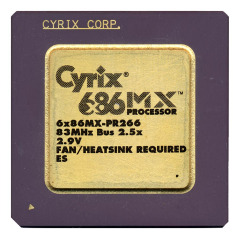
Launched in 1997The Cyrix 6x86MX is a late-generation Socket 7 x86 processor introduced in 1997 as an enhanced evolution of the original 6x86, designed to improve both feature set and competitiveness against Intel’s Pentium MMX by retaining Cyrix’s strong integer-oriented superscalar core while adding MMX support, a larger and more efficient cache subsystem, and improved overall balance. Internally, it uses a dual-issue, out-of-order x86 design with register renaming and instruction decoding into RISC-like internal operations, allowing relatively high integer performance per clock, although its floating-point unit remained weaker than Intel’s in many workloads. The 6x86MX also expanded the register set through support for Cyrix-specific architectural enhancements later associated with the MII branding, and typically integrated 64 KiB of unified L1 cache, substantially larger than the L1 cache found in contemporary Pentium-class competitors. Built for the Socket 7 infrastructure and standard 64-bit front-side bus platforms, the 6x86MX is best understood as Cyrix’s most advanced mainstream desktop core: architecturally ambitious, strong in office and integer-heavy software, but constrained by thermal characteristics, FPU performance, and market pressure from Intel and AMD.